How to Improve Edge Security Decisions with Session Enrichment

There has never been more security deployed at the edge than there is today. Content delivery networks (CDNs), web application firewalls (WAFs), and other edge security tools continually improve how organizations protect internet-facing applications.
Solutions like Cloudflare provide organizations with one of the most capable security platforms available, inspecting billions of requests every day, blocking known exploits, mitigating DDoS attacks, enforcing WAF policies, and stopping commodity bots. CDNs are the first line of defense for every user request. But at the same time, attackers have evolved.
Today's account takeover campaigns, credential stuffing attacks, fake account creation, inventory abuse, and AI-driven automation rarely arrive looking obviously malicious. They often originate from residential proxy networks, static ISP proxies, consumer VPNs, mobile carriers, legitimate cloud providers, or newly observed infrastructure that has never before been associated with abuse. Increasingly, attackers invest as much effort into appearing like legitimate users than they do into exploiting software vulnerabilities.
This has resulted in a shift in web security where it’s no longer enough to determine whether an HTTP request is malicious, but whether the session generating that request should be trusted.
This blog examines this shift and how security and fraud teams can add missing session trust to transform their CDNs into trust-aware decision engines.
Edge Security Is Exceptionally Good at What It Was Built to Do…
Today’s edge security stack combines everything from CDNs and WAFs, bot management, and DDoS mitigation to rate limiting, API protection, threat intelligence, challenge mechanisms, and rules engines. Together, these capabilities enable organizations to stop enormous volumes of malicious traffic before it ever reaches an application. Decisions can be made in milliseconds at the network edge, close to the user, and without introducing unnecessary latency. For most attacks, this works remarkably well, but modern fraud introduces a different problem.
…but the Hardest Traffic to Detect Isn't Obviously Malicious
Consider a credential stuffing campaign routed through a large residential proxy network. Every request may appear technically valid.
- The browser behaves normally.
- TLS fingerprints look legitimate.
- JavaScript executes successfully.
- The source IP belongs to an actual household.
- No individual IP makes more than one or two requests
Nothing about the individual request necessarily violates a WAF rule. But the attacker’s objective isn’t to just bypass a firewall, it’s rather to become indistinguishable from a legitimate customer, making detection and blocking more difficult.
This approach therefore changes what defenders need to understand. Instead of asking, "Is this request malicious?", security teams increasingly need to ask, "Can this session be trusted?"
The Missing Context: Network and Infrastructure Transparency
This is where session enrichment complements edge security. While CDNs excel at evaluating requests, session enrichment evaluates the trustworthiness of the session behind those requests.
Session enrichment provides an explainable trust assessment that includes transparent network and infrastructure-level attributes. It identifies anonymization technologies, residential proxy usage, VPNs, emerging proxy infrastructure, automation frameworks, AI-driven traffic, and other behaviors that are difficult to infer from individual requests alone.
But rather than just simply returning network attributes, session enrichment also provides a policy-ready decision object containing an enforcement recommendation, the reason for that recommendation, and the underlying session assessment that produced it. This enables Cloudflare Workers and other programmable edge platforms to make consistent, transparent, and auditable trust-aware enforcement decisions on intelligence that is often missing from existing security stacks.
Session enrichment doesn't replace a CDN – it increases the value of it by supplying intelligence it was never designed to produce.
Importantly, each session enrichment response includes a unique decisionId, enabling organizations to correlate authentication events with Cloudflare or other CDN logs, SIEM alerts, fraud investigations, and customer support cases. Rather than simply knowing a request was blocked, teams know why it was blocked and can trace that decision throughout downstream workflows.
Five Use Cases for Adding a Trust Layer to Prevent Authentication-Based Attacks
Following are five use case examples that demonstrate how session enrichment can improve edge enforcement using attributes in the session object below.
{"allowed": false,"reason": "Anonymous connections blocked","assessment": {"vpn": true,"proxied": false,"anon": true,"rdp": false,"dch": true,"cc": "US","ip": "146.70.202.60","ts": "2026-07-07T23:54:48Z","complete": true,"id": "35ea59be-539d-4f65-b699-77ddc13c5df2","sid": "test-app","service": "PROTON_VPN","cpd": "test-cpd-value","ai_agentic": false,"ai_crawling": false},"decisionId": "1a08c38d-810e-4a90-8705-dd3d9a76c529"}
Example #1: Applying Progressive Authentication for Anonymous Sessions
A login attempt originating from an anonymized VPN isn't automatically fraudulent, but it represents elevated uncertainty.
Consider the following session trust assessment:
{"allowed": false,"reason": "Anonymous connections blocked","assessment": {"vpn": true,"anon": true,"service": "PROTON_VPN","sid": "login"}}
allowedprovides an immediate policy outcome that the CDN or authentication workflow can consume.reasongives a clear, human-readable explanation for why the session requires additional scrutiny.vpnindicates the login originates from a commercial VPN.anonconfirms the connection is intentionally anonymized, increasing uncertainty during authentication.serviceidentifies the specific VPN provider, enabling provider-specific policies or investigations.siddemonstrates that this decision applies specifically to theloginworkflow, allowing organizations to apply different policies for login versus other user actions.
Rather than treating every VPN user as malicious, the authentication flow can introduce progressive friction only when trust signals warrant it. This approach increases confidence during login without unnecessarily challenging legitimate users.
Rather than forcing developers to build policy logic around individual attributes, session enrichment provides a policy-ready decision with a transparent explanation that Cloudflare or other CDNs can immediately enforce or customize.
Example #2: Implementing Stronger Controls During Account Creation
Fraudsters commonly create accounts through commercial VPNs and residential infrastructure to evade rate limits and reputation systems.
In the following example, the session trust assessment returned a decision to block an anonymous session in a signup (account creation) workflow based on these attributes:
- Commercial VPN originating from anonymous infrastructure.
- Identifying the specific provider.
{"allowed": false,"reason": "Anonymous connections blocked","assessment": {"vpn": true,"anon": true,"service": "PROTON_VPN","sid": "signup"}}
Because the response already contains an enforcement recommendation, organizations can immediately reject, challenge, or require step-up authentication without writing custom detection logic in their CDN.
Example #3: Applying Explainable Authentication Decisions
Consider the session trust assessment below, which contains the following attributes:
allowedis the policy decision.reasonis the reason behind the decision in human-readable language.vpn+anon+dchexplain why the session exceeded policy.serviceis useful for tuning or investigating recurring abuse from a provider.decisionIdenables auditability and correlation with Cloudflare logs, SIEM events, or fraud investigations.
{"allowed": false,"reason": "Anonymous connections blocked","assessment": {"vpn": true,"anon": true,"dch": true,"service": "PROTON_VPN"},"decisionId": "1a08c38d-810e-4a90-8705-dd3d9a76c529"}
Rather than receiving an opaque risk score, session enrichment ensures that analysts can see that the decision was driven by a combination of VPN usage, anonymization, and datacenter infrastructure. This transparency improves policy tuning and reduces unnecessary investigations.
Example #4: Escalating High-Risk Login Attempts
Authentication attempts originating simultaneously from anonymized infrastructure and data center hosting represent significantly higher risk than typical consumer VPN usage. These characteristics are commonly associated with automated credential attacks and malicious infrastructure and can identify sessions that deserve immediate intervention.
Consider the session trust assessment below, which contains the following attributes:
allowedindicates the session exceeded the organization's trust policy and should be blocked or immediately escalated.reasonexplains why the enforcement action occurred, improving transparency for analysts and administrators.vpnidentifies anonymization through a commercial VPN.anonsignals that the user is intentionally masking their network identity.dchindicates the session originates from datacenter infrastructure, which is more commonly associated with automated attacks and credential abuse than typical consumer traffic.decisionIdcreates a durable audit trail that can be correlated with Cloudflare logs, SIEM events, fraud investigations, and customer support cases.
{"allowed": false,"reason": "Anonymous connections blocked","assessment": {"vpn": true,"anon": true,"dch": true},"decisionId": "1a08c38d-810e-4a90-8705-dd3d9a76c529"}
The underlying assessment explains precisely why the session exceeded policy, making enforcement easier to validate and audit.
Example #5: Protecting Password Resets
Password reset is an especially sensitive workflow because it can immediately lead to account takeover. Therefore, a password reset request originating from anonymized infrastructure carries a different risk profile than a routine login because successful completion immediately grants control of the account.
In the following example, the session trust assessment returned the follow attributes:
allowedindicates that the password reset is denied or challenged.reasonexplains why the decision was made.vpn+anonrepresent a high-risk recovery request.serviceis useful for investigation and reporting.sidshows the policy is specific to the password reset workflow rather than all authentication events.decisionIdenables downstream correlation with SIEM events if the user contacts support or if analysts investigate the event.
{"allowed": false,"reason": "Anonymous connections blocked","assessment": {"vpn": true,"anon": true,"service": "PROTON_VPN","sid": "password-reset"},"decisionId": "1a08c38d-810e-4a90-8705-dd3d9a76c529"}
Complementing CDNs with Session Enrichment
The benefits of delivering session enrichment in your CDN even extend beyond authentication use cases.
CDN Capability | What Session Enrichment Adds | Business Impact | |
Deliver applications quickly and securely at the network edge. | Adds network-level session enrichment that enables more precise authentication and access decisions. | Transforms the CDN from a traffic enforcement platform into a trust-aware decision engine without replacing existing infrastructure. | |
Protect against volumetric DDoS attacks and common web exploits. | Identifies anonymized infrastructure, VPNs, residential proxies, and other high-risk sessions that appear legitimate to traditional edge controls. | Extends protection beyond network attacks to identity-based, precision targeted abuse like account takeover and credential stuffing. | |
Enforce WAF, bot, and security policies. | Enriches those policies with high-fidelity network attribution and session context to reduce false positives and improve enforcement accuracy. | Enables existing policies to become more precise, reducing unnecessary challenges and false positives by introducing another vector for consideration. | |
Inspect requests and enforce traffic rules. | Determines the trustworthiness of the individual session, not just the HTTP request or source IP. | Enables progressive enforcement based on who is behind the request, not just what the request looks like. | |
Provide a programmable enforcement platform (e.g., workers). | Supplies the session enrichment that powers those enforcement decisions without requiring organizations to build and maintain their own detection logic. | Enables organizations to deploy sophisticated, market validated session enrichment immediately instead of investing engineering effort to create and maintain proprietary detection models. |
Security Architecture Remains Unchanged
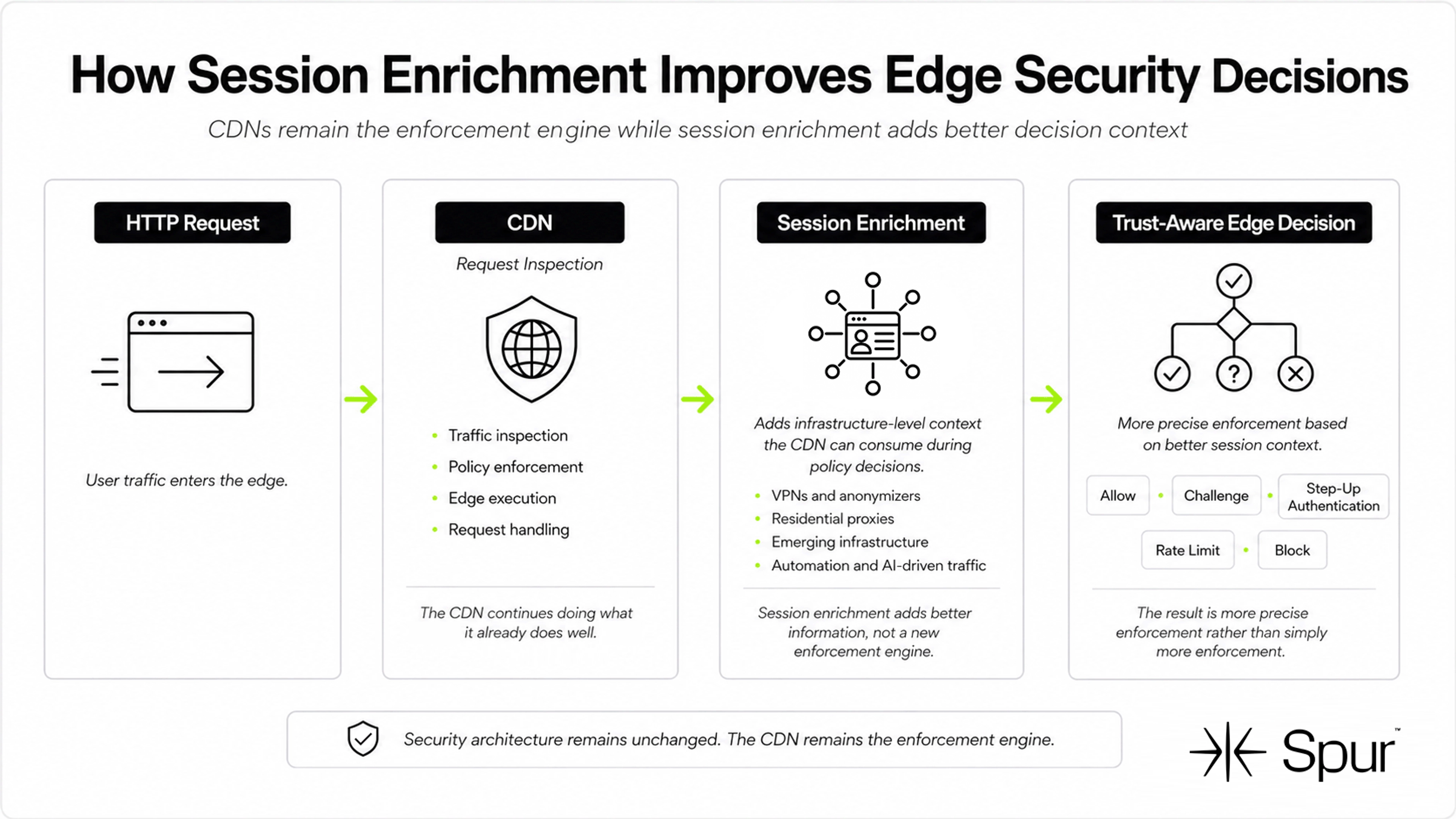
Perhaps the most important aspect of leveraging more comprehensive session enrichment in edge security is that it does not require organizations to rethink their security architecture. The CDN continues performing the functions it already performs exceptionally well – traffic inspection, policy enforcement, edge execution, and request handling – while session enrichment adds an additional layer – at the infrastructure level – that the CDN can consume during those policy decisions.
The important distinction is that the CDN remains the enforcement engine. Session enrichment simply gives it better information. The result is more precise enforcement rather than simply more enforcement.
The Future of Edge Security Is Better Session Enrichment
As attackers increasingly combine residential proxies, commercial VPNs, datacenter infrastructure, and agentic AI, session enrichment provides the context needed to distinguish trusted users from higher-risk sessions.
Edge security platforms will remain central to application protection because they provide the ideal location to make enforcement decisions – in real time before traffic reaches the application.
By combining CDN enforcement capabilities with real-time session enrichment, organizations gain deeper visibility into who is really behind a session, enabling them to reduce fraud, stop abuse earlier, and deliver stronger protection without introducing unnecessary friction for legitimate users.
How Spur Monocle Helps
Spur Monocle integrates directly with Cloudflare Workers and other programmable edge platforms so that organizations can immediately enrich existing authentication and security policies without redesigning their architecture. With Monocle, security and fraud teams can introduce progressive authentication, strengthen account creation defenses, protect password recovery workflows, reduce false positives, and apply consistent trust policies across every edge interaction.
For more information on how Spur Monocle complements Cloudflare and other CDN deployments with advanced session enrichment, check out the solution brief or try our zero-friction Cloudflare integration today.
See the Difference Between Raw Data & Real Intelligence
Start enriching IPs with Spur to reveal the residential proxies, VPNs, and bots hiding in plain sight.