Bot Detection: Exposing Automated and AI-Driven Activity Hiding Behind Legitimate Traffic

Bot detection is the practice of identifying automated activity attempting to mimic legitimate user behavior across applications, APIs, and digital workflows. That increasingly includes both traditional scripted bots and newer AI-driven agents capable of navigating workflows, maintaining session state, and adapting to defensive controls.
Effective bot detection now requires more than fingerprints, heuristics, or browser challenges alone. It also requires visibility into the infrastructure, proxy, and session context that reveals how automation is actually being delivered.
Behavioral bot management remains important. Infrastructure intelligence adds a complementary layer that helps security, fraud, and threat teams identify the anonymization and routing patterns stealthier automation relies on to evade traditional controls.
What Is Bot Detection?
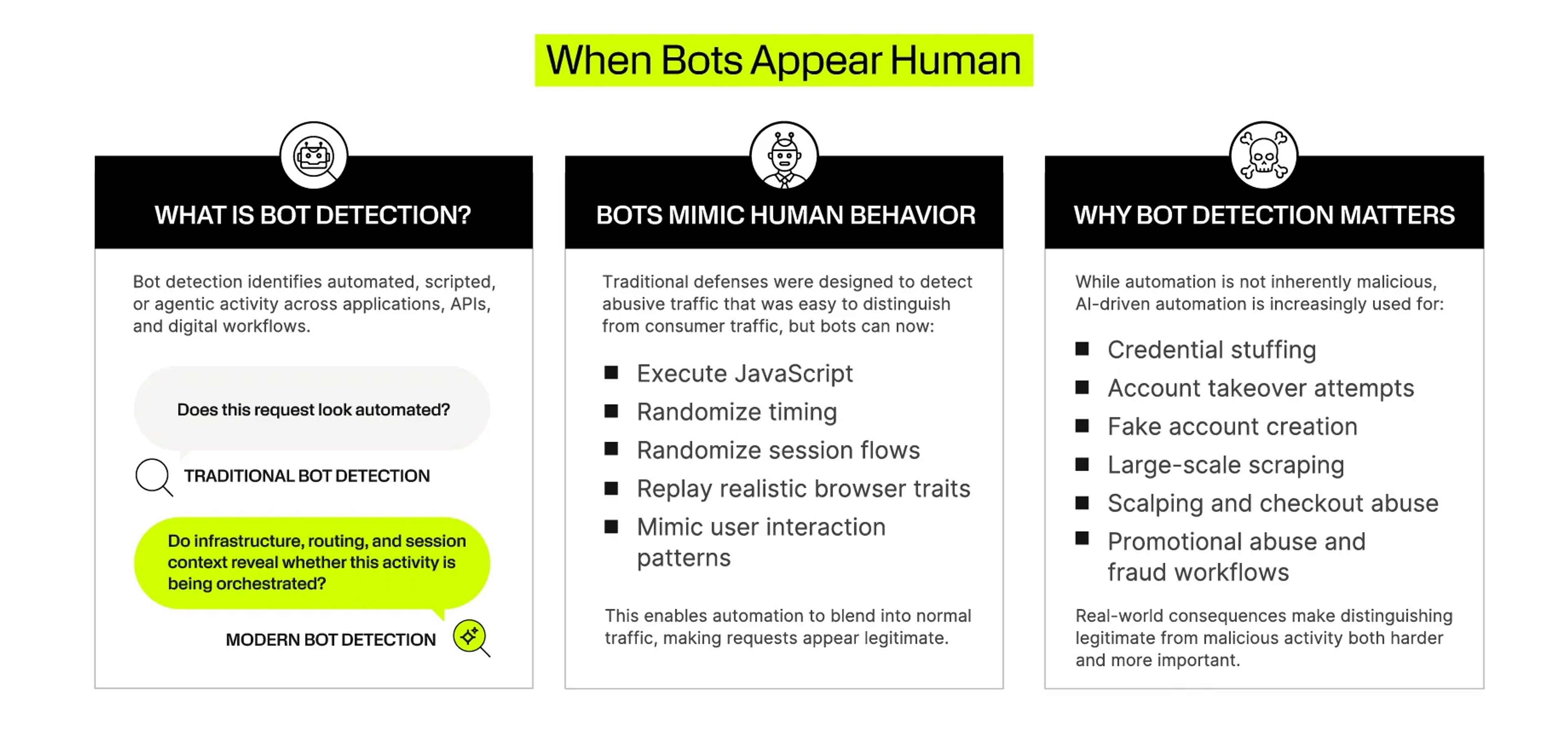
Bot detection involves identifying automated, scripted, or agentic activity across applications, APIs, and digital workflows.
Traditional bot detection often asks: Does this request look automated?
Modern bot and detection also asks: What infrastructure, routing, and session context reveal whether this activity is being orchestrated?
This distinction matters because many of today’s automated systems execute JavaScript, maintain session state, randomize timing, and mimic human interaction patterns. They may look legitimate at the surface while still relying on infrastructure that reveals automation at scale.
Why Bot Detection Matters
Automation is not inherently malicious. Organizations may want to enable certain types of crawling, indexing, or agentic interactions while blocking abuse.
At the same time, AI-driven automation is increasingly used for:
- Credential stuffing
- Account takeover attempts
- Fake account creation
- Large-scale scraping
- Scalping and checkout abuse
- Promotional abuse and fraud workflows
As automation becomes more adaptive and agentic, distinguishing legitimate from malicious activity becomes both harder and more important.
The Core Challenge: Human-Like Behavior, Non-Human Infrastructure
Modern automation increasingly succeeds at the request layer while failing at the infrastructure layer.
Bots can now:
- Execute JavaScript
- Randomize timing and session flows
- Replay realistic browser traits
- Mimic user interaction patterns
This enables automation to blend into normal traffic. Teams may simply see large volumes of residential IPs, valid browsers, and seemingly ordinary sessions.
What remains much harder to disguise is the infrastructure required to operate automation at scale.
This creates a central challenge:
- Surface behavior: Requests may appear legitimate
- Underlying reality: The traffic may still be coordinated through proxy networks, VPNs, datacenter infrastructure, and other anonymization layers
Why Traditional Bot Detection Falls Short
Many traditional bot defenses were designed for a world where abusive traffic was noisy, centralized, and easy to distinguish from consumer traffic.
Common Limitations
IP Reputation
Historical blocklists are less effective when automation rotates through residential proxies, mobile carrier space, and IPs with no prior abuse history.
Velocity-Based Detection
Distributed orchestration keeps per-IP request volume low, making large-scale abuse harder to detect through simple rate limits.
Fingerprinting
Modern automation frameworks can execute JavaScript, patch headless indicators, and replay realistic device and browser traits.
ASN Blocking
Blocking broad hosting ranges or infrastructure classes creates false positives and fails when abuse shifts into residential and mobile IP space.
These approaches still have value, but they are no longer sufficient on their own.
Easy Bots vs. Stealthy Bots
Some automated traffic is relatively easy to identify. Self-declared crawlers, obvious hosting infrastructure, and unsophisticated automation often expose enough surface-level signals for conventional controls to work.
The harder problem is stealthier automation. These systems execute JavaScript, mimic human timing, and blend into normal web traffic by routing through residential proxies, VPNs, and other anonymization layers. That is where infrastructure intelligence becomes critical.
A “One-Two Punch” Is Necessary
Modern bot detection is most effective when multiple layers work together:
- Traditional bot management and behavioral controls catch obvious or lower-sophistication automation
- Infrastructure intelligence exposes the anonymization and routing layers that stealthier automation relies on
Together, these layers provide a more durable approach than either one alone.
A Better Approach: Infrastructure-Aware Detection
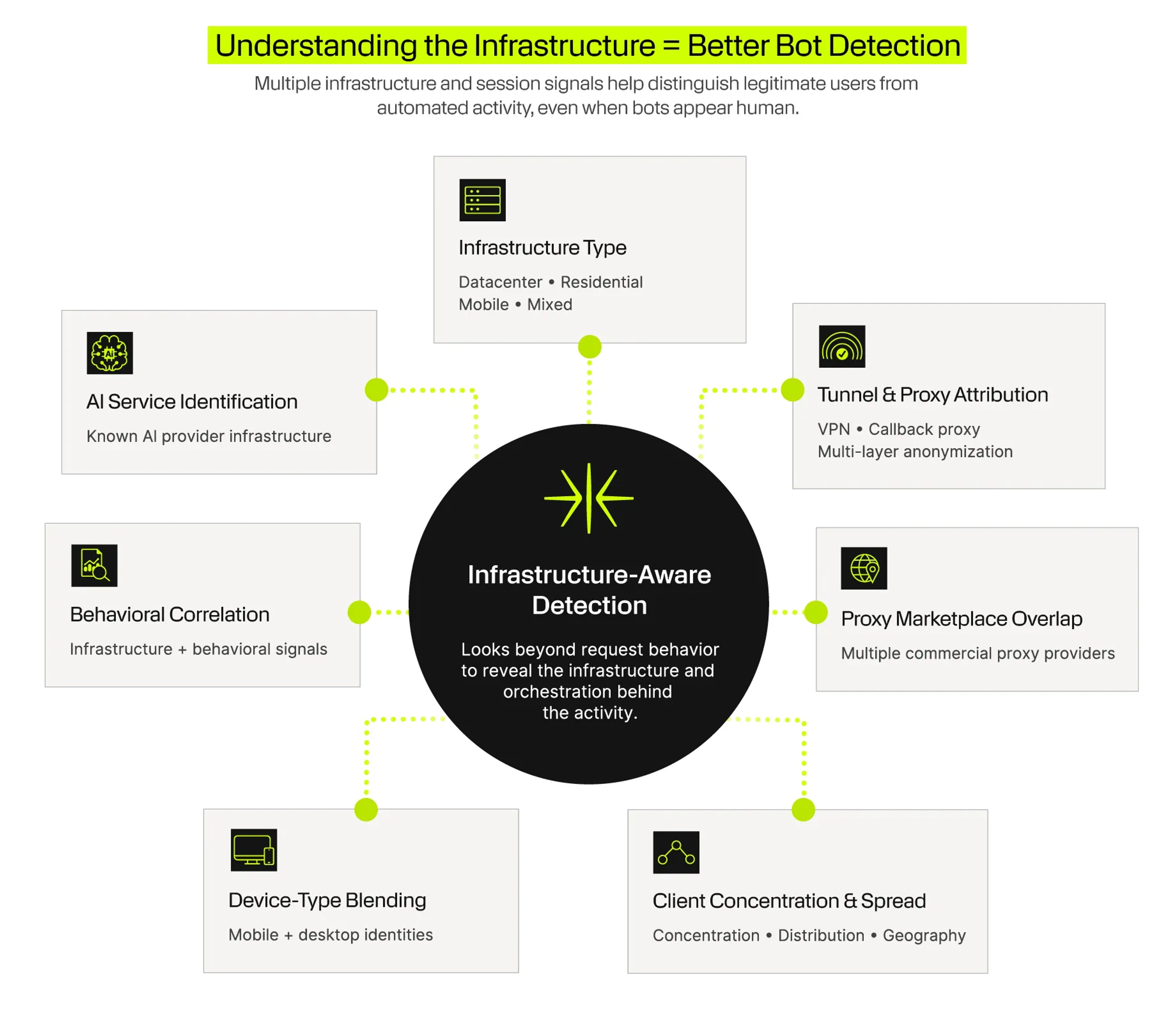
Effective bot detection requires understanding the infrastructure and orchestration behind the request.
Rather than asking only whether a request behaves like a bot, infrastructure-aware detection asks whether the surrounding network, proxy, and session context is consistent with legitimate use.
This is especially important because modern automation increasingly blends into normal traffic. From the perspective of the application, teams may simply see large volumes of residential IPs, valid browsers, and apparently normal interactions. The underlying infrastructure tells a different story.
Key Signals and Techniques
- Infrastructure type: Identify whether traffic originates from datacenter, residential, mobile, or mixed infrastructure
- Tunnel and proxy attribution: Detect VPN tunneling, callback proxies, and multi-layer anonymization patterns
- Proxy marketplace overlap: Look for traffic associated with multiple commercial proxy providers, which is uncommon for legitimate users but common in automated campaigns
- Client concentration and spread: Measure where users behind an IP are concentrated and how broadly activity is distributed across regions
- Device-type blending: Identify unusual mixing of mobile and desktop identities across shared infrastructure
- Behavioral correlation: Combine infrastructure signals with indicators such as file-sharing behavior, TOR usage, or identity-level anomalies
- AI service identification: Label infrastructure associated with known AI providers to reduce ambiguity and distinguish AI service-associated traffic from generic cloud activity
Viewed together, these signals help distinguish coordinated automation from independent user activity.
What AI & Bot Detection Looks Like in Practice
AI and automation detection requires comparing what a session appears to be doing with the infrastructure and context required to deliver it.
Example Detection Scenario
A session appears to originate from a datacenter IP in Frankfurt and initially looks like ordinary cloud-hosted traffic.
However, additional context reveals:
- The connection is associated with known AI service infrastructure
- The AI operator is identified as OpenAI
- The activity type is classified as agentic
- The IP belongs to Microsoft infrastructure rather than consumer or enterprise end-user access
At the surface level, the request may look like normal datacenter traffic. The added context shows that the session is associated with AI service infrastructure rather than a typical human-operated endpoint.
Example Enriched IP Output
{"ip": "135.220.73.223","ai": {"operator": "OPENAI","types": ["AGENTIC"]},"organization": "Microsoft Limited","as": {"number": 8075,"organization": "Microsoft Corporation"},"infrastructure": "DATACENTER","location": {"city": "Frankfurt am Main","state": "Hesse","country": "DE"}}
What This Shows
- AI service association: The IP is linked to a known AI provider and classified as agentic activity
- Datacenter-hosted origin: The connection originates from hosted infrastructure rather than a typical end-user environment
- Provider context: Microsoft-owned infrastructure provides additional clarity about the network environment serving the request
- Location context: The session resolves to datacenter infrastructure in Frankfurt rather than consumer access tied to an individual user
Taken together, these signals do not indicate proxy chaining or disguised residential traffic. They show that the request is associated with known AI service infrastructure and should be evaluated differently from a normal human-operated session.
Decision Context
With this level of visibility, teams can:
- Apply step-up authentication or targeted friction
- Block or rate-shape high-risk automation
- Separate desirable AI activity from abusive orchestration
- Flag activity for fraud, abuse, or security investigation
How Bot Detection Solves Real-World Use Cases
Detect Bots and Automation Abuse
Attackers distribute scripted traffic across residential proxies, VPNs, and rotating infrastructure to blend into normal application traffic.
Infrastructure-aware detection reveals the networks and routing patterns behind this activity, helping teams identify and control abuse even when request behavior appears human.
Prevent Fake Account Creation
Account farming campaigns use automated onboarding flows, synthetic identities, and distributed IP space to evade per-IP thresholds and fraud checks.
By exposing proxy-backed automation, shared infrastructure, and abnormal client patterns, AI and bot detection helps teams stop large-scale sign-up abuse earlier in the workflow.
Stop Account Takeovers and Credential Stuffing
Credential stuffing and automated login attacks increasingly rely on infrastructure rotation rather than high request velocity. In many cases, attackers keep request volume per IP extremely low, sometimes only a few attempts per address, while rotating through large residential proxy pools.
Correlating tunnels, proxy overlap, geographic inconsistency, and identity-centric anomalies helps teams string together these seemingly unrelated attempts and identify the shared infrastructure behind them.
Prevent Payment Fraud and Checkout Abuse
Automated purchase attempts, transaction abuse, and checkout scripting often operate through anonymized infrastructure to avoid controls.
Infrastructure-aware enrichment helps teams apply friction or intervention based on risk without broadly disrupting legitimate customers.
Protect Applications and APIs at Scale
Automation increasingly targets APIs, account endpoints, export workflows, and promotional systems where it can generate the highest adversarial return.
By identifying infrastructure risk and correlated automation patterns, organizations can apply more durable controls across web and API environments.
Detect Scalping and High-Demand Release Abuse
Scalping campaigns distribute purchase attempts across large proxy ecosystems to bypass inventory controls and per-IP purchase limits.
In one retail deployment, investigators initially identified one proxy network involved in abusive traffic. With deeper infrastructure intelligence, they uncovered more than 100 related networks, enabling more targeted enforcement and a significantly stronger release outcome.
Surface AI-Assisted Employment and Insider-Risk Abuse
Some hiring and onboarding workflows are now targeted by AI-assisted, geographically spoofed applicants using VPNs, residential proxies, and automation to appear local and legitimate.
Infrastructure and location context can help expose orchestrated applicant activity and reduce risk in workflows where identity, geography, and trust matter.
Enable Desirable AI and Agentic Interactions
Not all AI-driven activity is unwanted. Some organizations may want to allow scraping, indexing, or specific agentic providers while blocking abuse from others.
AI service identification helps distinguish between crawlers, which are typically used for indexing and data collection, and agents, which perform more interactive or task-oriented activity. This enables policy-based enforcement for acceptable automation without treating all AI traffic as malicious.
How to Implement Bot Detection
Defending against unwanted automation requires a layered, context-aware approach rather than a single detection mechanism.
1. Adopt a Layered Detection Architecture
Combine infrastructure intelligence, device and browser telemetry, behavioral signals, and identity-level anomalies.
2. Treat Infrastructure Type as a Risk Multiplier
Use infrastructure class, proxy status, and tunnel signals to influence enforcement decisions.
3. Apply Progressive and Adaptive Friction
Use targeted CAPTCHA, MFA, step-up verification, delayed processing, or rate shaping based on risk.
4. Monitor Identity-Centric Anomalies
Look for high IP turnover per account, ASN switching, device reuse across geographies, and inconsistent session patterns.
5. Segment and Harden High-Value Workflows
Prioritize account registration, authentication, payment flows, promotions, and data export or API endpoints.
6. Continuously Recalibrate Against Evolving Proxy Ecosystems
Update controls as new proxy providers, VPN chaining behaviors, and mobile carrier patterns emerge.
What to Look for in a Bot Detection Solution
Not all bot detection solutions are designed for modern distributed and agentic automation.
Infrastructure Awareness
Solutions should identify the network and routing reality behind a request, not just surface behavior.
Residential Proxy and VPN Detection
Detection should account for the anonymization layers most commonly used to disguise automation.
Explainable Signals
Teams should be able to see the attributes supporting a decision, such as service attribution, ASN, tunnel behavior, and proxy overlap.
Real-Time and Historical Analysis
Effective solutions should support both inline decisioning and large-scale retrospective analysis.
Flexible Enforcement
Controls should support blocking, friction, scoring, and investigation across different environments and latency requirements.
AI Service Identification
As AI-originated traffic grows, solutions should help distinguish AI provider-associated infrastructure from generic cloud activity and proxy-backed abuse.
Low False-Positive Design
Detection should preserve experience for legitimate users and desirable automation, not rely on blanket blocking.
Conclusion
Bot abuse detection is no longer just about identifying obvious bots. It is about exposing the infrastructure and orchestration behind traffic that is deliberately designed to appear legitimate.
By combining infrastructure intelligence, proxy attribution, session context, and AI service identification, organizations can move beyond brittle request-layer controls and make more precise decisions about which activity to allow, challenge, or block.
As automation becomes more adaptive, agentic, and infrastructure-aware, organizations need detection strategies that are equally resilient.
Bot Detection: Frequently Asked Questions
Bot detection is the practice of identifying automated activity across web applications, APIs, and digital workflows. Modern bot detection increasingly includes both traditional scripted automation and AI-driven agents that attempt to mimic legitimate users.
Traditional bot management often emphasizes fingerprints, JavaScript challenges, and behavioral heuristics. Modern bot detection increasingly adds infrastructure and routing context to expose automation that appears human at the request layer.
Yes. Residential proxy detection is increasingly critical because sophisticated automation often hides within legitimate consumer ISP space to evade traditional controls.
No. Some AI-driven traffic may be desirable, including approved crawling, indexing, monitoring, or agentic interactions. Effective bot detection helps distinguish acceptable automation from abuse.
Spur helps teams detect bots by exposing the network infrastructure behind automated traffic. Modern bots often route activity through VPNs, residential proxies, mobile gateways, cloud infrastructure, and other anonymization services to make automation appear human.
Spur enriches IPs and sessions with verified infrastructure context, including proxy and VPN attribution, ASN, geolocation, connection type, tunnel behavior, and other signals that help teams distinguish real users from automated or agentic activity. Teams can use Spur to add network-level bot detection context to authentication, fraud, application security, and abuse workflows.
Learn more about Spur AI & Bot Detection.
See the Difference Between Raw Data & Real Intelligence
Start enriching IPs with Spur to reveal the residential proxies, VPNs, and bots hiding in plain sight.