Fraudulent Account Prevention: Exposing Fraud at Signup Before Fake Accounts Are Created

Fraudulent account prevention is the practice of identifying and stopping abusive signups before fake or high-risk accounts are created. In modern digital platforms, that increasingly requires understanding the infrastructure, anonymization, and session context behind registration activity, not just the form submission itself.
Open registration flows are essential for growth, but they are also one of the easiest entry points for abuse. The challenge is not simply blocking more signups. It is making earlier, more accurate, and more explainable decisions that reduce fraud without unnecessarily reducing conversions.
What Is Fraudulent Account Creation?
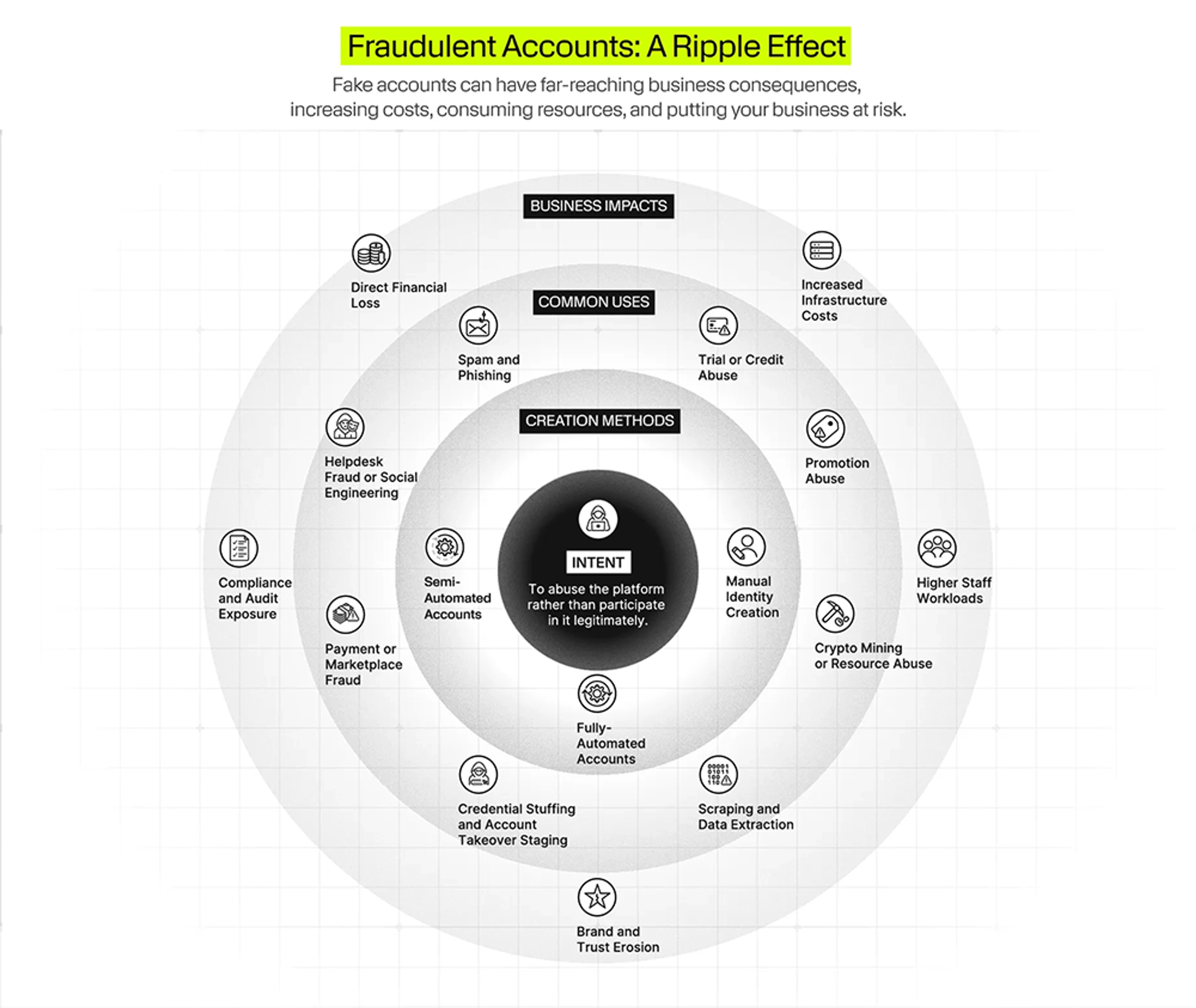
Fraudulent account creation refers to the registration of accounts that are not controlled by genuine end users acting in good faith. These accounts may be fully automated, semi-automated, or manually created using false, stolen, or synthetic identity data.
The defining characteristic is intent. The account exists to abuse the platform rather than participate in it legitimately.
Fraudulent accounts are commonly used for:
- Spam and phishing
- Trial or credit abuse
- Promotion abuse
- Crypto mining or resource abuse
- Scraping and data extraction
- Credential stuffing and account takeover staging
- Downstream payment or marketplace fraud
- Downstream helpdesk fraud or social engineering
Why Fraudulent Account Creation Matters
Fraudulent signups are often treated as a nuisance problem, but they have direct operational and financial consequences.
Common Business Impacts
- Direct loss from free credits, trials, referrals, or subsidized services
- Increased infrastructure and storage costs from fake accounts
- Higher analyst and support workload
- Brand and trust erosion when platforms are used for scams or spam
- Compliance and audit exposure in regulated environments
The underlying problem is structural: registration is intentionally designed to be easy for legitimate users, while fraudsters are highly motivated to automate and obscure their activity. The economics of signup fraud extend beyond direct losses. Many organizations now absorb additional costs from SMS-based MFA, identity verification, and manual review workflows, making risk-based decisioning increasingly important for both security and cost control.
The Core Challenge: Fraud Hides Behind Legitimate-Looking Signups
Fraudulent signup activity rarely looks obviously malicious at the surface. Increasingly, it blends into normal traffic by using residential proxies that appear as legitimate home IP addresses, making fake signups difficult to distinguish from genuine users without infrastructure intelligence.
Attackers now combine:
- Automation frameworks that simulate browsers and solve CAPTCHAs
- Stolen or synthetic identity data
- Disposable emails and SMS verification farms
- VPNs, residential proxies, and mobile proxies that make signup activity appear to come from legitimate users
- Rapid IP rotation across large proxy pools that makes coordinated abuse appear distributed and independent
This creates a difficult tradeoff for digital platforms:
- Too little friction: Fraudsters create and weaponize accounts at scale
- Too much friction: Legitimate users abandon signup and conversion suffers
The goal is not blanket blocking. It is using better context to distinguish legitimate signups from coordinated fraud.
Why Traditional Signup Controls Fall Short
Most organizations already use layered controls to protect registration flows. These controls are valuable, but many were designed for adjacent problems such as DDoS protection, request validation, or basic bot mitigation.
Common Limitations
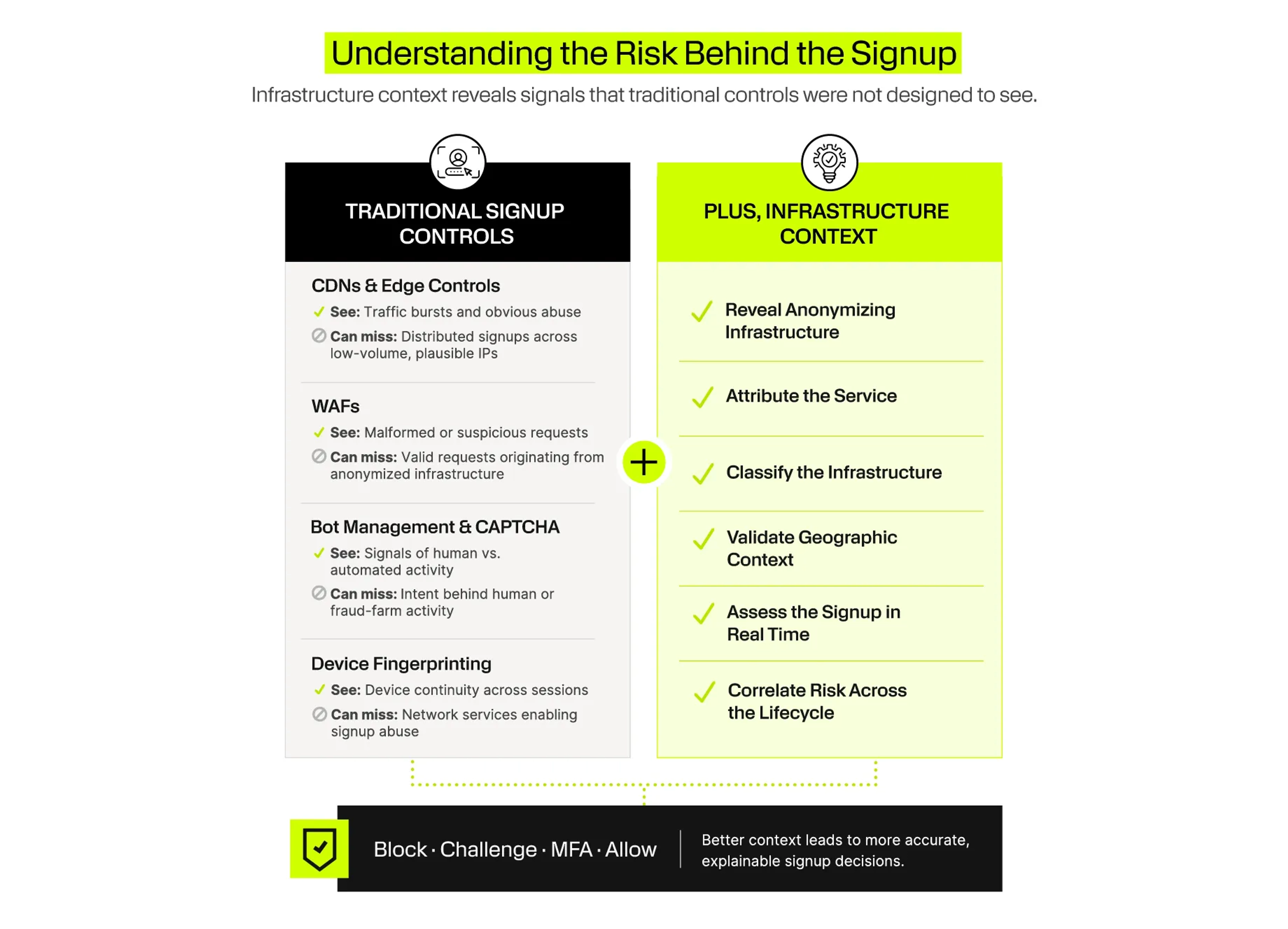
CDNs and Edge Controls
These help absorb bursts, block malformed requests, and stop obvious abuse. They are less effective when attackers distribute signups across thousands of low-volume, geographically plausible IPs.
WAFs
WAFs can block malformed or suspicious requests, but a valid signup request from anonymized infrastructure often passes inspection. They see the request, not the infrastructure risk behind it.
Bot Management and CAPTCHA
These tools help distinguish humans from automation, but they do not reliably assess intent. A human using a VPN, proxy, or fraud farm can still create a high-risk account.
Device Fingerprinting
Device signals provide continuity across sessions, but they can be reset, rotated, or fragmented. On their own, they reveal little about the network services enabling signup abuse.
These controls still matter and are not replaced by IP and session intelligence. The missing piece is infrastructure context, a layer of visibility that helps existing controls make better decisions.
A Better Approach: Treat Signup Risk as Infrastructure Context
Fraudulent account creation is best understood as a distributed systems problem. Attackers change scripts, identities, and workflows, but they repeatedly rely on third-party infrastructure to scale.
Infrastructure and session intelligence help answer questions other controls cannot:
- Is this signup coming from infrastructure designed for anonymity?
- Is this network commonly associated with scaled abuse?
- Does the session context align with normal consumer or enterprise usage?
- Should this signup be blocked, challenged, delayed, or allowed?
Key Signals and Techniques
- VPN and proxy attribution: Identify commercial VPNs, residential proxy networks, and other anonymizing services used to scale abuse
- Anonymization flags: Detect when traffic is associated with infrastructure designed to obscure origin
- Service-level attribution: Distinguish between specific VPN or proxy providers rather than relying on generic “risky IP” scoring
- Data center and infrastructure classification: Determine whether traffic is coming from hosting, residential, mobile, or mixed infrastructure
- Geographic consistency: Evaluate whether location, network type, and session context align logically
- Real-time session context: Assess individual signup sessions at the point of registration
- Lifecycle correlation: Re-evaluate high-value signals later across login, password reset, profile changes, and monetization events
Viewed together, these signals provide infrastructure context that supports more accurate, explainable signup decisions.
What Fraudulent Account Prevention Looks Like in Practice
Stopping fraudulent signups requires evaluating the registration attempt as a risk-bearing session, not just a form submission.
Example Detection Scenario
A new account registration appears to come from a plausible U.S. user and successfully completes the signup form.
However, the session carries additional context:
- The IP is associated with a known commercial VPN service
- Anonymization flags indicate the traffic is designed to conceal origin
- The signup is tied to a sensitive registration workflow where risk tolerance is lower than for casual browsing
- The infrastructure does not clearly align with normal consumer signup behavior
At the surface level, the request looks valid. At the infrastructure level, it indicates a signup attempt that warrants closer scrutiny.
Example Session Output
{"vpn": true,"proxied": false,"anon": true,"rdp": false,"dch": false,"cc": "US","ip": "198.51.23.210","ipv6": "2001:db8:e214:9f67:711:f03e:a141:3871","ts": "2022-10-17T14:03:19-04:00","complete": true,"id": "580f12c9-8030-4d49-b39f-35dfe560fa9e","sid": "example-sign-up-form","service": "MULLVAD_VPN","cpd": "test-cpd-value"}
What This Shows
- Known anonymization infrastructure: The session is associated with a commercial VPN provider, adding explainability and confidence at the session level
- Anonymization intent: The vpn and anon flags suggest the traffic is intentionally designed to conceal origin
- Workflow sensitivity: The session is tied directly to a signup flow, where tolerance for risk is lower than in read-only browsing
- Structured session context: The output provides attributes that can be combined with device, identity, and behavioral signals rather than forcing a binary allow or deny decision
Taken together, these signals do not prove malicious intent on their own. They provide the infrastructure context needed to apply proportionate friction or additional verification before an account is created.
Decision Context
With this level of visibility, teams can:
- Allow low-risk registrations to proceed
- Trigger additional identity verification or delayed activation
- Challenge signups tied to high-risk anonymization infrastructure
- Block accounts that combine strong proxy/VPN risk with other signs of abuse
- Target user risk with session-level accuracy below busy IPs
Real-World Impact
In one deployment, a global technology company used high-fidelity anonymized IP intelligence to determine that more than 90% of fraudulent account signups were tied to high-risk proxy connections. By cutting fraudulent account creation by more than 90%, the company reduced account creation costs by more than $500,000 per month and achieved an approximately 40x return on investment.
How Fraudulent Account Prevention Solves Real-World Use Cases
Prevent Trial and Credit Abuse
Fraudsters create large numbers of accounts to extract trial access, signup credits, referral bonuses, or subsidized services.
Infrastructure-aware signup decisions help identify proxy-backed abuse before fraudulent accounts are created and monetized.
Stop Spam, Phishing, and Messaging Abuse
Fake accounts are often used to weaponize built-in communication features for phishing, scams, or spam campaigns.
By blocking or challenging high-risk signups at registration, organizations can reduce downstream abuse before it reaches users or damages brand trust.
Reduce Promotion and Incentive Abuse
Attackers frequently create large numbers of accounts to exploit offers, rewards, or discount programs.
Session and IP intelligence help distinguish normal signup behavior from distributed, anonymized registration campaigns built for extraction.
Support KYC and Identity Verification Workflows
In regulated environments, onboarding controls need to balance user experience with confidence in who is creating an account.
In sectors such as financial services, KYC requirements create a need for greater confidence in user identity and location at onboarding. Infrastructure context helps determine when additional verification is justified, enabling teams to avoid both blanket friction and weak onboarding controls.
Improve Conversion Without Accepting More Risk
Aggressive signup controls often reduce fraud by increasing friction for everyone.
Explainable infrastructure signals help teams apply targeted intervention, preserving conversion for low-risk users while concentrating scrutiny on the signups most likely to be abusive.
Correlate Risk Across the Account Lifecycle
A signup that appears borderline acceptable at registration may become clearly high-risk when the same account later rotates through anonymized infrastructure or triggers suspicious login and monetization patterns.
Treating signup risk as part of the full account lifecycle improves accuracy and reduces false positives over time.
How to Implement Fraudulent Account Prevention
The most effective organizations do not treat signup fraud as a binary blocking problem. They align multiple controls around a shared, risk-based decision model.
1. Treat IP and Session Intelligence as Infrastructure Context
Use high-fidelity IP and session signals to add context other controls cannot provide. These signals should inform decisions rather than act as static blocklists.
2. Shift from Binary Blocking to Risk-Based Decisioning at Signup
Known anonymizing services, proxy attribution, and session-level risk should influence whether a signup is allowed, challenged, delayed, or denied.
3. Correlate Signals Across the Account Lifecycle
Re-use high-value signup signals later in login, password reset, profile changes, and monetization events to improve confidence and reduce false positives.
4. Combine Infrastructure, Identity, and Behavioral Signals
The best decisions come from combining network-level context with device, email, phone, fingerprint, and workflow signals.
5. Preserve Conversion with Targeted Friction
Apply stronger controls only when infrastructure and session context justify them. This protects user experience while reducing abuse.
What to Look for in a Fraudulent Account Prevention Solution
Not all signup fraud controls are designed to reveal the infrastructure behind abuse.
Explainable Infrastructure Signals
Teams should be able to see why a signup is risky, including VPN/proxy attribution, network type, and session-level context.
Real-Time Session-Level Detection
Decisions at signup need current context, not stale lists or historical summaries.
Residential Proxy and VPN Coverage
A strong solution should identify the anonymizing services most commonly used to scale fraudulent signups.
Risk-Based Policy Support
Controls should support selective challenge, delayed activation, identity verification, and blocking rather than forcing only binary decisions.
Lifecycle Integration
Signup risk should be reusable across login, identity checks, and downstream abuse monitoring.
Low False-Positive Design
The goal is to stop more abuse without penalizing legitimate user acquisition and conversion.
Conclusion
Fraudulent account creation is not just a registration problem. It is the first step in many larger abuse campaigns, from spam and promotion abuse to phishing, fraud, and downstream account compromise.
The most effective defenses do not rely solely on edge rules, CAPTCHAs, or simple IP lookups. They combine existing controls with explainable infrastructure and session context to make earlier, more accurate signup decisions.
By treating fraudulent account creation as a risk-based, infrastructure-aware problem, organizations can stop more abuse before accounts exist while preserving the fast, fair signup experience legitimate users expect.
Fraudulent Account Prevention: Frequently Asked Questions
Fraudulent account creation is the registration of accounts that are not intended for legitimate use. These accounts may be automated, semi-automated, or manually created using false, stolen, or synthetic identity data.
Fraudsters rely on VPNs, residential proxies, and mobile proxies to make large numbers of signups appear geographically plausible and difficult to connect to a single source.
No. VPN use alone does not always imply malicious intent. The goal is to combine infrastructure signals with session, behavioral, and identity context to make risk-based decisions.
Bot detection focuses on whether an interaction appears automated. Fraudulent account prevention also considers the intent and infrastructure behind the signup, including whether the account is likely to be abusive even if the interaction appears human.
Spur helps prevent fraudulent account creation by detecting the anonymized infrastructure attackers use to make fake signups look legitimate. Fraud rings often rely on residential proxies, VPNs, automation, and shared infrastructure to create accounts at scale while avoiding basic signup controls.
Spur provides verified IP and session context that helps teams identify proxy-backed signups, coordinated account creation, suspicious geography, and infrastructure reuse. This allows teams to block, challenge, or review risky signups before fraudulent accounts are created and abused.
Learn more about how Spur helps prevent fraudulent account creation.
See the Difference Between Raw Data & Real Intelligence
Start enriching IPs with Spur to reveal the residential proxies, VPNs, and bots hiding in plain sight.