Account Takeover Prevention: Exposing Risky Login Infrastructure Behind Modern ATO Campaigns

Account takeover prevention is the practice of detecting and disrupting attempts to gain unauthorized access to legitimate user accounts. In modern environments, that requires understanding the infrastructure, anonymization, and session context behind authentication activity, not just whether credentials were entered correctly.
Modern ATO campaigns do not succeed only because credentials are weak or stolen. They succeed because attackers combine compromised credentials, automation, social engineering, and anonymized infrastructure to make malicious logins appear legitimate.
However, the goal of ATO prevention is not blanket friction. It is making more precise authentication decisions that reduce takeover risk without degrading the experience of legitimate users.
What Is an Account Takeover?
An account takeover occurs when an attacker gains unauthorized control over a legitimate user account. This may happen through stolen credentials, session hijacking, cookie theft, adversary-in-the-middle attacks, compromised recovery workflows, or other techniques that enable the attacker to bypass or defeat authentication safeguards.
In more advanced cases, stolen sessions are routed through anonymized infrastructure to avoid detection, making infrastructure context important even after initial authentication has been bypassed.
ATOs are often a precursor to:
- Fraudulent transactions
- Data theft or exposure
- Unauthorized account changes
- Lateral movement into adjacent systems
- Customer trust and brand damage
The account itself is legitimate. What changes is who controls it.
Why Account Takeovers Matter
Account takeovers are one of the most costly and persistent forms of digital abuse.
Common Business Impacts
- Direct financial losses from fraud or unauthorized transfers
- Higher operational costs for investigations, claims, and remediation
- Increased pressure on fraud, IAM, and support teams
- Customer churn and reputational damage after account compromise
- Regulatory scrutiny in heavily regulated industries
The challenge is especially difficult for consumer-facing platforms. Legitimate users expect fast access to accounts, funds, and services, while defenders need enough context to detect abuse without forcing every login through blanket friction.

The Core Challenge: Modern ATO Campaigns Exploit Anonymized Infrastructure
Modern ATO campaigns rarely present as obvious login abuse from a single source. Instead, they often blend into normal traffic by using residential proxies and other anonymized infrastructure that make malicious access appear to come from ordinary users.
Attackers now combine:
- Stolen credential pairs from breach repositories and phishing campaigns
- Password spraying and credential stuffing techniques designed to avoid lockouts
- Session replay and cookie theft in more advanced attacks
- MFA fatigue and other social engineering methods
- Adversary-in-the-middle attacks that proxy authentication sessions in real time and capture session tokens even when MFA is enabled
- VPNs, residential proxies, and other anonymizing services that make login attempts appear geographically plausible and distributed
This enables login abuse to blend into normal traffic. From the defender’s perspective, malicious attempts may look like routine authentication activity coming from ordinary consumer IP space.
Attackers also increasingly exploit the user as the weakest link. MFA fatigue attacks, sometimes called push bombing, repeatedly trigger authentication prompts until a user approves one out of frustration or confusion. When paired with anonymized infrastructure, these attacks become harder to attribute because the malicious session appears to come from ordinary user traffic rather than obvious attack infrastructure.
Modern phishing campaigns also use adversary-in-the-middle techniques to proxy authentication sessions in real time. These attacks can capture credentials or session tokens while still presenting what appears to be a valid login flow. Infrastructure intelligence helps surface the proxy-backed network context behind these authentication attempts, even when the session itself appears legitimate.
That creates a difficult tradeoff:
- Too little friction: Attackers gain access to accounts at scale
- Too much friction: Legitimate users are slowed down, challenged unnecessarily, or locked out
The goal is not to challenge every risky-looking login. It is to identify the infrastructure and tradecraft that distinguish malicious access from normal user behavior.
Why Traditional Authentication Controls Fall Short
Most organizations already use layered authentication defenses, but many of them are optimized for adjacent problems such as password hygiene, static risk scoring, or generic bot detection.
Common Limitations
Credential Validation and Password Policies
These help reduce weak-password abuse, but they do not reveal whether successful or unsuccessful login attempts are coming from anonymized infrastructure.
MFA and Step-Up Authentication
MFA remains critical, but attackers increasingly use MFA fatigue, session hijacking, or social engineering to work around it. Blanket MFA also adds cost and friction when applied too broadly.
Velocity and Lockout Controls
Per-IP or per-account rate limits are less effective when attackers distribute login attempts across large pools of VPN or residential proxy IPs.
IP Reputation and Basic Geolocation
Coarse IP reputation and simple country-level geolocation often miss the infrastructure layer that makes ATO traffic difficult to distinguish from normal usage.
These controls still matter and are not replaced by IP intelligence. The missing layer is infrastructure context, visibility into where login traffic is actually coming from and how it relates to known abuse ecosystems.
A Better Approach: Treat Login Risk as Infrastructure Context
Effective ATO prevention requires adding context to network origin and authentication events.
Rather than asking only whether a login succeeded, came from a new geography, or triggered a behavioral anomaly, infrastructure-aware detection asks deeper questions:
- Is this login coming from a VPN, residential proxy, or hosting provider?
- Does the IP appear reused across unrelated users, geographies, or sessions?
- Is the traffic associated with tunnel behavior, callback proxy risk, or proxy marketplace overlap?
- Should this login proceed normally, trigger step-up authentication, be slowed, or be blocked?
Key Signals and Techniques
- VPN and proxy attribution: Identify commercial VPNs, residential proxy networks, and anonymizing services commonly used in ATO campaigns
- Infrastructure classification: Distinguish datacenter, residential, mobile, and mixed infrastructure
- Tunnel and callback detection: Surface anonymous tunneling and proxy chaining behavior
- IP reuse across users or regions: Detect login infrastructure that appears shared across unrelated sessions or geographies
- Geographic inconsistency: Compare apparent exit location with client concentration or related usage patterns
- Behavioral context: Combine infrastructure signals with login anomalies, device changes, and account behavior
- Session-aware enforcement: Apply infrastructure context to authentication workflows, trust thresholds, and high-risk actions after login
When viewed together, these signals help identify coordinated login abuse that would otherwise look like ordinary authentication traffic.
What Account Takeover Prevention Looks Like in Practice
Modern ATO detection requires evaluating the authentication event as more than a successful or failed login. The real question is whether the surrounding infrastructure and session context match legitimate user behavior.
Example Detection Scenario
A login attempt appears to come from a valid user session originating from Amsterdam, Netherlands.
However, additional context reveals:
- The IP is hosted in datacenter infrastructure
- The connection is associated with OpenVPN and Proton VPN
- Multiple commercial proxy providers are linked to the same client context
- Usage concentration points to India rather than the apparent exit location
- Prior behavioral indicators include TOR and file-sharing-related activity
At the surface level, the authentication event may look like a normal login. At the infrastructure level, it reflects anonymized access patterns commonly associated with coordinated ATO activity.
Example Enriched IP Output
{"as":{"number":49981,"organization":"WorldStream"},"client":{"behaviors":["FILE_SHARING","TOR_PROXY_USER"],"concentration":{"city":"Polāia Kalān","country":"IN","density":0.2675,"geohash":"tsn","skew":6762,"state":"Madhya Pradesh"},"count":4,"countries":2,"proxies":["ABCPROXY_PROXY","9PROXY_PROXY","NETNUT_PROXY","GOPROXY_PROXY"],"spread":4724209,"types":["MOBILE","DESKTOP"]},"infrastructure":"DATACENTER","ip":"89.39.106.191","location":{"city":"Amsterdam","country":"NL","state":"North Holland"},"organization":"WorldStream B.V.","risks":["CALLBACK_PROXY","TUNNEL","GEO_MISMATCH"],"services":["OPENVPN"],"tunnels":[{"anonymous":true,"entries":["89.39.106.82"],"operator":"PROTON_VPN","type":"VPN"}]}
What This Shows
- Datacenter-hosted infrastructure: The login originates from hosting infrastructure often associated with anonymized access
- Known VPN usage: OpenVPN exposure and an identified Proton VPN tunnel raise confidence that the session is intentionally anonymized
- Proxy marketplace overlap: Multiple proxy providers are linked to the same client context, which is highly atypical for legitimate users
- Geographic mismatch: The apparent exit location in the Netherlands does not align with observed client concentration in India
- Shared and distributed usage: Multi-country spread and multiple client types suggest reused infrastructure rather than a single user behaving normally
- Behavioral risk indicators: TOR-associated and file-sharing behavior strengthen the case that this login is part of an abuse-oriented environment
Taken together, these signals do not simply indicate an unusual login. They point to infrastructure and tradecraft commonly used to deliver account takeover attempts while avoiding static detection and simple rate controls.
Decision Context
With this level of visibility, teams can:
- Allow low-risk logins to proceed normally
- Trigger step-up authentication only when infrastructure risk is elevated
- Increase scrutiny on high-risk account actions later in the session
- Detect and investigate patterns across apparently unrelated login attempts
Real-World Impact
In one financial services deployment, high-fidelity IP intelligence helped reduce successful account takeovers by more than 40% without introducing meaningful user friction. In another, a bank used granular IP intelligence to enrich real-time login activity and threat profiling, enabling near-zero malicious logins from high-confidence proxy-driven threats.
How Account Takeover Prevention Solves Real-World Use Cases
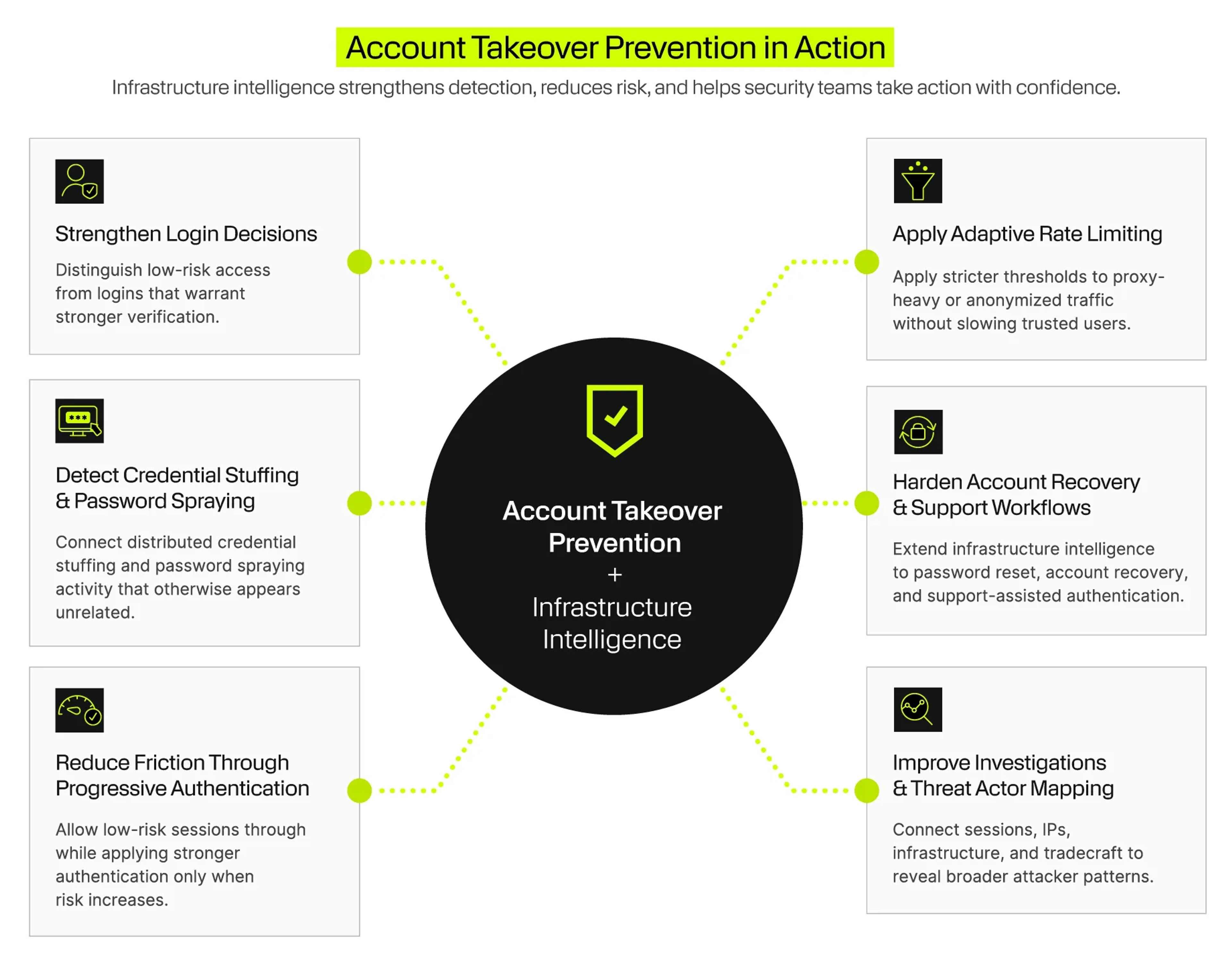
Strengthen Login Decisions
Not every login from a VPN or unfamiliar network should be blocked. The challenge is knowing when a login deserves more scrutiny.
Infrastructure context helps authentication systems distinguish between low-risk access and login attempts that warrant step-up verification, stronger MFA, or delayed access.
Detect Credential Stuffing and Password Spraying Patterns
Attackers distribute login attempts across large VPN and residential proxy pools to stay below per-IP thresholds.
By correlating proxy reuse, shared infrastructure, geographic inconsistency, and login anomalies, organizations can string together login attempts that would otherwise appear unrelated.
Reduce Friction Through Progressive Authentication
Blanket MFA and rigid login controls increase cost and frustrate legitimate users.
A more effective model is progressive authentication: use infrastructure context to allow low-risk sessions to continue while increasing scrutiny only when login behavior or later account actions cross a trust threshold.
Organizations also increasingly face per-transaction costs for SMS-based MFA and push notifications, making blanket authentication economically difficult to sustain. Infrastructure-aware risk scoring supports more selective MFA and step-up verification, reducing both security risk and unnecessary operational cost.
Apply Adaptive Rate Limiting
Static rate limits are easy for distributed ATO campaigns to evade.
Infrastructure-aware rate limiting enables organizations to apply stricter thresholds to known proxy-heavy or anonymized traffic while letting trusted traffic flow normally.
Harden Account Recovery and Support Workflows
Account recovery, password reset, and support-assisted authentication are frequent targets for escalation after initial compromise.
Applying the same IP intelligence to these workflows helps reduce the chance that attackers bypass stronger login controls through recovery or support channels.
Improve Investigations and Threat Actor Mapping
ATO campaigns often span multiple sessions, IPs, and proxy services.
When logs are enriched with high-fidelity IP intelligence, teams can move beyond isolated event review and begin to identify shared infrastructure, repeated tradecraft, and distinct attacker patterns.
How to Implement Account Takeover Prevention
The most effective ATO programs do not treat every login as equally risky, and they do not rely on a single control. They align authentication, fraud, and infrastructure signals around a shared decision model.
1. Add Context to Network Origin
Enrich authentication events with high-fidelity IP intelligence so login decisions include infrastructure and anonymization context, not just credentials and geography.
2. Strengthen Authentication Decisions
Use VPN, proxy, and infrastructure signals to determine when step-up authentication or phishing-resistant MFA is justified.
3. Detect Login Patterns Across Sessions
Look for rapid IP rotation, shared infrastructure, and login reuse patterns that reveal credential stuffing or proxy-backed ATO campaigns.
4. Apply Adaptive Rate Limiting
Adjust rate limits and friction dynamically based on infrastructure risk rather than relying on static thresholds alone.
5. Harden Account Recovery Workflows
Use the same context layer across recovery, reset, and support-assisted flows so attackers cannot bypass one control surface by shifting to another.
6. Extend Trust Decisions Beyond Login
Carry session and infrastructure tags into high-risk actions such as adding payment methods, changing account details, or initiating transfers.
What to Look for in an Account Takeover Prevention Solution
Not all ATO defenses are designed to reveal the infrastructure attackers use to scale and disguise login abuse.
High-Fidelity VPN and Proxy Detection
A strong solution should identify commercial VPNs, residential proxies, and anonymized infrastructure with enough specificity to support action.
Explainable Infrastructure Signals
Teams should be able to see why a login is risky, including provider attribution, tunnel behavior, infrastructure type, and related proxy signals.
Real-Time and Historical Visibility
Organizations need both inline decisioning for authentication workflows and retrospective analysis for investigations and threat pattern discovery.
Adaptive Enforcement Support
The solution should support step-up authentication, risk-based friction, adaptive rate limiting, and session-aware controls.
Low False-Positive Design
The goal is to disrupt more ATO activity without introducing meaningful friction for legitimate users.
Workflow Consistency
The same infrastructure intelligence should be usable across login, recovery, transaction, and support workflows.
Conclusion
Account takeover prevention is no longer just about protecting passwords or adding more login friction. Modern ATO campaigns succeed by combining stolen credentials with anonymized infrastructure, automation, and adaptive tradecraft.
The most effective defenses add explainable infrastructure context to authentication decisions, enabling organizations to identify risky login patterns, apply proportional controls, and preserve a smoother experience for legitimate users.
By treating ATO risk as an infrastructure-aware, session-aware problem, organizations can disrupt more takeover attempts while reducing unnecessary friction and improving investigative confidence.
ATO Prevention: Frequently Asked Questions
An account takeover occurs when an attacker gains unauthorized control over a legitimate user account, often through stolen credentials, session hijacking, or abuse of recovery workflows.
Attackers use VPNs and residential proxies to obscure origin, rotate geography, and distribute login attempts in ways that evade simple IP-based detection and rate controls.
No. VPN usage alone does not always imply malicious intent. The goal is to use infrastructure context to decide when a login should proceed, when it should trigger step-up authentication, and when it should be blocked or investigated.
Basic IP reputation often treats IPs as good or bad at a coarse level. Account takeover prevention benefits from deeper context such as provider attribution, tunnel behavior, infrastructure type, reuse patterns, and related session signals.
Spur helps teams prevent account takeovers by revealing the anonymized infrastructure behind risky login attempts. Attackers often use VPNs, residential proxies, and automated infrastructure to make credential-stuffing and account takeover activity look like normal user behavior.
Spur enriches authentication events with verified IP intelligence, including VPN and proxy attribution, ASN, geolocation, connection type, and other network-origin signals. This helps security and fraud teams identify suspicious logins, apply targeted step-up controls, and reduce account takeover risk without adding unnecessary friction for legitimate users.
Learn more about how Spur helps stop account takeovers.
See the Difference Between Raw Data & Real Intelligence
Start enriching IPs with Spur to reveal the residential proxies, VPNs, and bots hiding in plain sight.