The Hidden Economy of Your Internet Connection

How bandwidth sharing fuels residential proxy networks and quietly turns everyday devices into infrastructure for cybercrime
While many free applications are supported by advertising, subscriptions, or open-source communities, others rely on less visible forms of monetization. One increasingly common – and often poorly understood – example is bandwidth sharing.
Bandwidth sharing enables a third party to use your internet connection through embedded software. This software is frequently bundled into legitimate apps or installed by malware operators on infected devices. Because these applications do not typically need additional security permissions for bandwidth sharing, the user is unaware that their device is enabling this activity.
In addition to the frequent lack of user knowledge or user consent over bandwidth sharing, this gray market supply enables threat actors to convert arbitrary software installations into pseudo-legitimate revenue streams. This means, for example, malware can install bandwidth sharing software to create real passive revenue streams to a bandwidth sharing marketplace. With residential proxy prices dropping 60-75% in the last 5 years, providers are always looking to shore up additional revenue streams.
Bandwidth sharing endpoints are resold through services that frequently market themselves as residential proxies. These often dubious services exist entirely to obfuscate the origin of web traffic and to bypass traditional network security tools.
This post examines this shadow market of bandwidth sharing and how to redefine trust on the modern internet.
How Residential Proxies Work
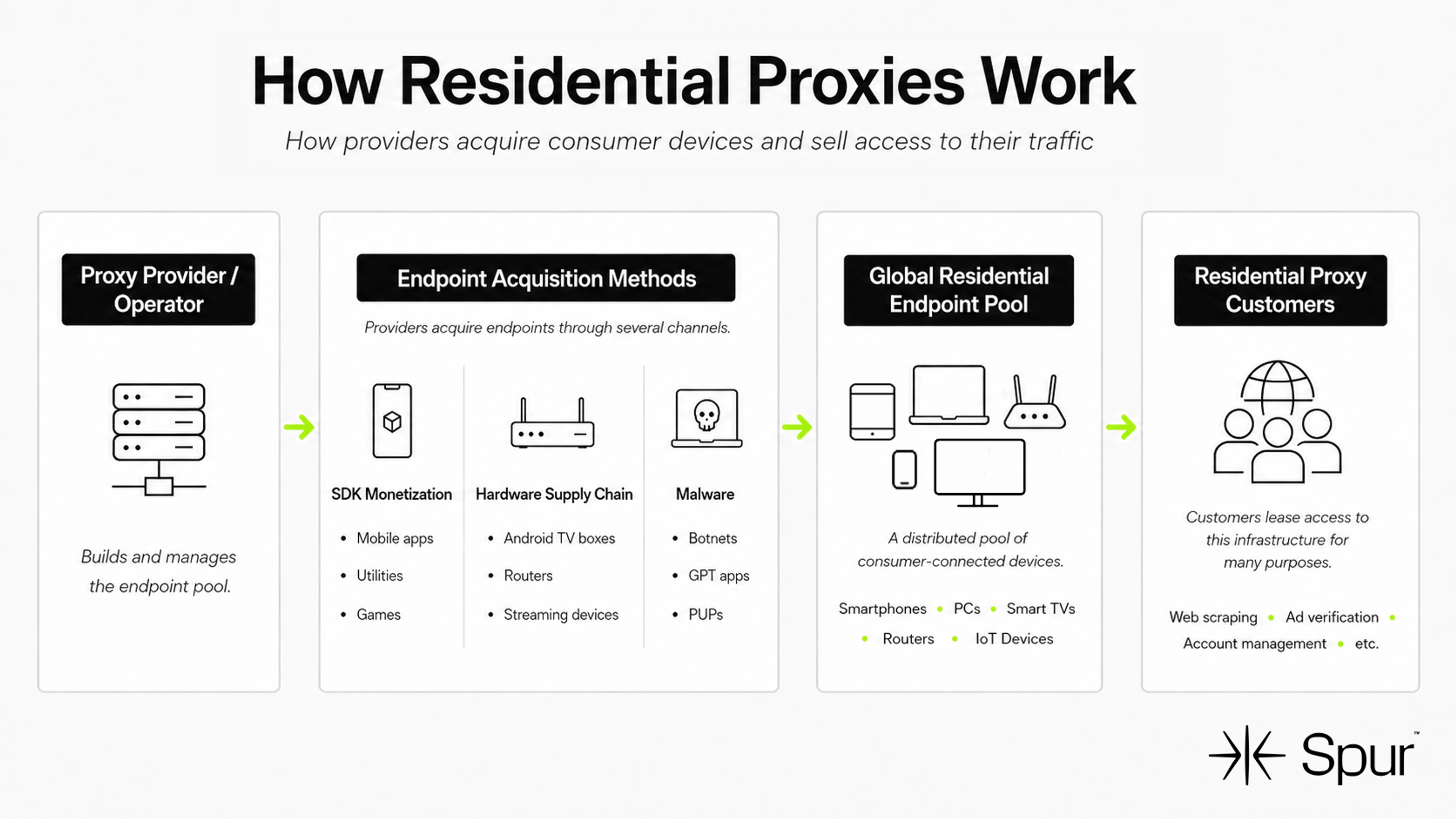
In the context of residential proxy networks, endpoint sourcing refers to the collection of individual consumer devices into their massive, global proxy “pools.” These endpoints consist of everyday hardware like smartphones, desktop computers, home routers, and smart TVs. When a device belongs to a “pool” it can serve as the exit node for proxy network traffic, using the IP address of the device running the software.
Proxy operators have followed similar approaches and strategies to older botnets in how they build, grow, and fill their proxy pools. The larger the pool of devices, the more valuable it becomes. Proxy providers leverage various tactics to encourage adoption and gain access to a user's device and bandwidth. This ranges from transparent “Get-Paid-To” applications and embedded monetization SDKs in mobile games, to deceptive, gray-area practices like malware payloads and pre-installed proxy firmware on cheap hardware.
SDK-Based Sourcing
One of the primary engines of growth for proxy networks is the Monetization SDK. Proxy providers market these libraries to mobile app developers as a "passive income" alternative to intrusive ads. When a developer embeds one of these SDKs into a seemingly benign application (e.g., a flashlight utility, PDF scanner, or casual mobile game), the user’s device silently becomes an exit node in that proxy provider’s pool.
Because bandwidth sharing is framed as a background process and uses existing network connectivity permissions, it routinely bypasses app store security reviews. Consumers download a free tool, often completely unaware that their device's IP address and network capacity are actively being sold to third parties. If the user actually gives consent, it is typically buried inside a long and verbose Terms of Service (ToS) that the user never actually inspects or understands.
App developers who incorporate bandwidth sharing SDKs into their apps will frequently get paid on a per GB of data basis with “quality” multipliers depending on how well an IP evades tools like Captchas or rate-limits.
Hardware-Level Sourcing and Supply Chain
While app stores provide a steady stream of mobile IPs, the "heavy lifting" is increasingly done by pre-installed software on cheap, unbranded hardware.
For example, Android TV Boxes and low-cost streaming devices, often used for accessing pirated content, frequently ship with "factory-installed" proxy firmware. Because these devices are already operating in a gray-market ecosystem, users are statistically less likely to report suspicious outbound traffic or performance degradation.
In many cases, the proxy software is not an "app" but a background service integrated into the OS build directly. This makes removal nearly impossible for the average consumer and ensures a 24/7 "always-on" connection that mobile devices cannot provide.
Malware Sourcing
As endpoint operating system protections and anti-virus tools have improved at catching overt malware like ransomware, threat actors have pivoted to quieter, highly lucrative recurring revenue models. Instead of dropping traditional malicious code, malware operators use their botnets to silently install "legitimate" Get-Paid-To (GPT) bandwidth-sharing applications onto compromised machines. Because these applications are often backed by registered corporate entities, security software frequently classifies them as benign or merely Potentially Unwanted Programs (PUPs). This enables the malware operator to launder illicit device access into clean, legitimate corporate disbursements based on the bandwidth harvested from victims.
This is an important development in the malware ecosystem because access to highly profitable, unlaundered, “legitimate” revenue streams creates an extremely high incentive to compromise additional devices. In some cases, a proxy provider may turn a blind eye and claim that their software is being installed by legitimate users with proper consent and control. In other cases, the malware author and the proxy provider may be the same entity, but the proxy company provides a “front” for legitimate revenue from illicit exploitation activities.
Incentives and the Illusion of Consent and Authorization
The entire ecosystem of residential proxies hinges on a fragile definition of user consent. Proxy providers require a veneer of authorization to operate within the bounds of legal gray areas and maintain their payment processing infrastructure. However, the gap between theoretical consent and informed consent is vast, purposefully designed to keep the endpoint owner in the dark.
The Illusion of the Terms of Service
When consent is technically obtained, it is almost always obfuscated. Opt-in disclosures are routinely buried deep within a dense Terms of Service agreement or disguised with vague language about “improving network routing” or ”participating in a distributed network.” The average consumer clicks, “I Agree” to access a free app, entirely ignorant of the fact that they have authorized third-party proxy routing.
Developer and Affiliate Incentives
The true incentive structure bypasses the end-user entirely. Proxy networks pay app developers directly based on the number of active nodes or gigabytes transferred. This creates a financial motive for developers to hide the SDK's presence and maximize its uptime, prioritizing proxy performance over the app's core functionality or the user's battery life.
Get-Paid-To (GPT) Asymmetry
In cases where users directly install bandwidth-sharing applications for compensation, the financial incentives are drastically asymmetrical. Users are paid pennies for gigabytes of transferred data, bearing the total cost of ISP data caps, electricity, and the inherent risk of having their IP address associated with malicious traffic. Additionally, in nearly all of these cases the user cannot provide true network consent to this activity as the internet service provider has explicitly prohibited this activity on their network.
Criminal Enablement: Re-sale and Access
Once endpoint access is harvested, pooled, and packaged, it is sold on the open or gray market. The barrier to entry for accessing these massive IP pools is exceptionally low, enabling malicious actors to simply purchase the infrastructure required for large-scale attacks.
Proxy providers operate polished, corporate storefronts that completely detach the buyer from the murky reality of how the endpoints were sourced. Access can be purchased using credit cards or cryptocurrency, featuring dashboards that allow criminals to target specific geographic regions, cities, or even specific internet service providers (ISPs). This enables an attacker in one jurisdiction to appear as a legitimate local resident elsewhere, effectively neutering geo-fencing and traditional IP reputation controls.
Because these networks support versatile protocols like SOCKS5 and HTTP, the purchased proxies integrate seamlessly into automated attack scripts. Threat actors utilize this clean residential bandwidth to conduct high-volume credential stuffing, inventory scalping, ad fraud, and aggressive web scraping. The attacker enjoys the cloak of a legitimate residential connection, the proxy network profits from the wholesale of bandwidth, and the end-user absorbs the degradation of service and the reputational damage to their IP address.
Consumer Harm Beyond Cybersecurity
The risks associated with bandwidth sharing extend well beyond cybersecurity and platform abuse. At its core, this ecosystem creates a consumer protection problem because the individuals supplying the underlying infrastructure often lack meaningful knowledge of, or control over, how their internet connection is being used.
Consumers may experience direct economic harm through increased bandwidth consumption, degraded device performance, shortened battery life, higher electricity costs, and potential overage charges from internet service providers. In many cases, these costs exceed the small financial incentives offered by bandwidth-sharing programs. Furthermore, endpoint-based proxies frequently create local network vulnerabilities, increasing the risk of compromise or identity theft.
More concerning is the imbalance of information between providers and consumers. Users are frequently asked to consent to participation through lengthy Terms of Service or vague disclosures that fail to explain the practical consequences of allowing third parties to route traffic through their connection. Consumers may not understand that their IP address could become associated with criminal activity, fraud investigations, abusive traffic, or violations of website terms of service.
This creates a marketplace in which consumers bear the risks primarily while the financial benefits accrue to software developers, proxy operators, and resellers. From a consumer protection perspective, meaningful consent should require clear disclosures, understandable explanations of risk, and the ability to easily opt out without losing access to core product functionality.
Recommendations
The growth of residential proxy networks represents a fundamental failure in the "trust" model of the internet. To combat this, app stores across mobile devices, smart TVs, and desktop operating systems should consider improving transparency to provide the actual, informed consent that proxy providers claim to collect. For example, mobile app stores, smart TV marketplaces, and desktop software distribution platforms could add explicit, high-visibility disclosures (ideally enforced at the permission level) for any SDK that harvests device bandwidth, treating it with similar severity as location, microphone, or camera permissions.
Major storefronts are beginning to recognize this threat, though enforcement remains a continuous game of whack-a-mole against obfuscated code. Google Play, for instance, has recently tightened its “Device and Network Abuse” policies, explicitly stating that apps facilitating proxy services may only do so if it is the “primary, user-facing core purpose of the app.” This has enabled them to terminate developer accounts caught silently embedding residential proxy SDKs into benign utilities. Similarly, the Apple App Store leverages its notoriously strict guidelines on background processing and resource usage to reject apps that hijack device connections for undisclosed monetization. However, because proxy SDKs are frequently disguised as standard analytics or crash-reporting libraries, they still routinely slip through automated reviews.
To definitively close this loophole, marketplaces should move beyond policy updates and implement standardized, OS-level permission prompts that explicitly warn the user about “Background Bandwidth Sharing” or local network access before the software is ever allowed to activate.
Also, consumer protection authorities should evaluate whether undisclosed or inadequately disclosed bandwidth-sharing practices constitute deceptive or unfair business practices, particularly when consumers are unable to reasonably understand the risks, costs, or intended use of their network resources.
Explicitly reselling network access has severe security implications that can bypass external IP-based authorization controls or even enable lateral movement inside a home or corporate network. At a minimum, platform owners must force a user to consent truly and undeniably to anyone using their network.
See the Difference Between Raw Data & Real Intelligence
Start enriching IPs with Spur to reveal the residential proxies, VPNs, and bots hiding in plain sight.