How to Detect and Govern Agentic AI Traffic with Session Enrichment

Why Agentic AI Traffic Requires a New Approach to Detection and Governance
Artificial intelligence is rapidly becoming both a consumer of digital content and an active participant in online workflows. Large language models continuously collect public data for model training. AI assistants browse websites on behalf of users. Autonomous software agents create accounts, complete transactions, interact with APIs, and automate research without direct human involvement.
This growth should change how organizations think about identity and trust. Traditional security controls were designed to distinguish humans from bots, but today's challenge is more nuanced – distinguishing authorized (wanted) autonomous interactions from unauthorized (unwanted) ones.
Not every AI interaction is malicious of course. Organizations increasingly want to allow some AI platforms while restricting others, permit research while preventing bulk extraction, or enable customer-facing AI assistants without exposing sensitive content to automated harvesting. These are policy decisions rather than purely security decisions, and making those decisions requires understanding the environment in which each session originates – not simply identifying an IP address or parsing a User-Agent string.
This post examines the growing usage of agentic traffic, gaps in current approaches to govern it, and how session enrichment adds essential context to improve decision making.
What’s Driving The Rise of Agentic Traffic
AI-generated traffic has grown dramatically over the past two years. Cloudflare observes that website traffic from AI agents and bots now accounts for 57% of web traffic compared to 43% human-generated. This is to be expected as search engines increasingly answer questions using AI-generated summaries; AI assistants browse the web before responding to users; and autonomous agents perform competitive research, comparison shopping, account management, customer support interactions, and purchasing workflows. Meanwhile, every major AI model provider continuously collects web content for training and retrieval-augmented generation (RAG).
The challenge is that these interactions are becoming increasingly difficult to distinguish from legitimate users. Agentic platforms often rotate infrastructure through residential proxy networks, distribute requests globally, maintain cookies, and execute JavaScript exactly as legitimate users do. Some platforms intentionally avoid obvious automation signatures to maximize compatibility with modern websites.
From an application's perspective, these sessions frequently appear indistinguishable from ordinary human browsing.
The Risks and Benefits of Agentic AI Traffic
Organizations should not assume all autonomous traffic is malicious. As examined above, many forms of agentic interaction provide legitimate value, so blocking all automated traffic would reduce discoverability, break integrations, and frustrate customers who increasingly expect AI-assisted experiences.
At the same time, AI introduces significant abuse opportunities. Autonomous platforms can:
- Harvest proprietary documentation
- Extract pricing and inventory at scale
- Collect content for unauthorized model training
- Circumvent usage policies through residential proxy infrastructure
- Create synthetic accounts
- Perform credential attacks using AI-generated behavior
- Conduct denial-of-inventory attacks
- Continuously probe APIs for undocumented functionality
- Execute autonomous purchasing or scalping workflows
The objective is therefore not to block AI outright. Instead, it is to determine which autonomous interactions align with business policy.
Common Methods for Detecting Agentic Traffic and Their Limitations
Organizations typically rely on several techniques to identify AI traffic.
User-Agent Detection
Many AI platforms publish recognizable User-Agent strings. Examples include GPTBot, ClaudeBot, PerplexityBot, Bytespider, and others. This approach works well for cooperative crawlers. However, autonomous browser agents frequently use standard Chrome or Edge User-Agent strings indistinguishable from human users. User-Agent inspection therefore identifies only the most transparent AI platforms.
AI Crawler IP Allowlisting and Blocklisting
Some AI providers publish crawler IP ranges. These can be allowed or blocked using firewalls, CDNs, or WAF policies, but this works only while providers continue using dedicated infrastructure. Increasingly, however, autonomous platforms execute through:
- VPN providers
- Residential proxy services
- Consumer broadband
- Cloud browsers
- Virtual desktops
- Remote browser execution platforms
Static IP allowlists therefore become increasingly ineffective.
robots.txt for AI Crawler Control
robots.txt remains useful for well-behaved search engines, but it has no enforcement capability. Any autonomous platform choosing to ignore robots.txt can continue collecting data without restriction.
Bot Management and AI Agent Detection
Modern bot management tools analyze browser automation, JavaScript execution, behavioral telemetry, and device fingerprints. The technology remains extremely valuable for detecting automation, but many were designed primarily to answer whether a browser is automated, not whether an autonomous interaction should be permitted according to policy.
For example, a sophisticated AI browser executing from an approved enterprise environment may be acceptable. But the same browser executing through a commercial VPN to harvest proprietary content may violate policy.
Why AI Traffic Detection Needs Session Enrichment
Session enrichment complements existing AI detection methods by providing explainable, policy-ready context around every autonomous interaction. Rather than simply identifying network characteristics, session enrichment returns an enforcement recommendation, the reason behind that recommendation, the supporting session assessment, and a unique decision identifier. Organizations can therefore move beyond simply detecting autonomous interactions to consistently governing them according to business policy.
Session enrichment can answer questions such as:
- Is the session originating from anonymous infrastructure?
- Is the connection traversing a commercial VPN?
- Is the traffic associated with a known proxy network?
- Is the interaction executing from remote desktop infrastructure?
- Is the apparent geography consistent?
- Which anonymization service is actually being used?
These attributes provide context that traditional bot detection cannot observe. Then, instead of treating every AI interaction equally, organizations can apply differentiated policy based on risk, shifting AI governance from binary blocking to more intelligent policy enforcement.
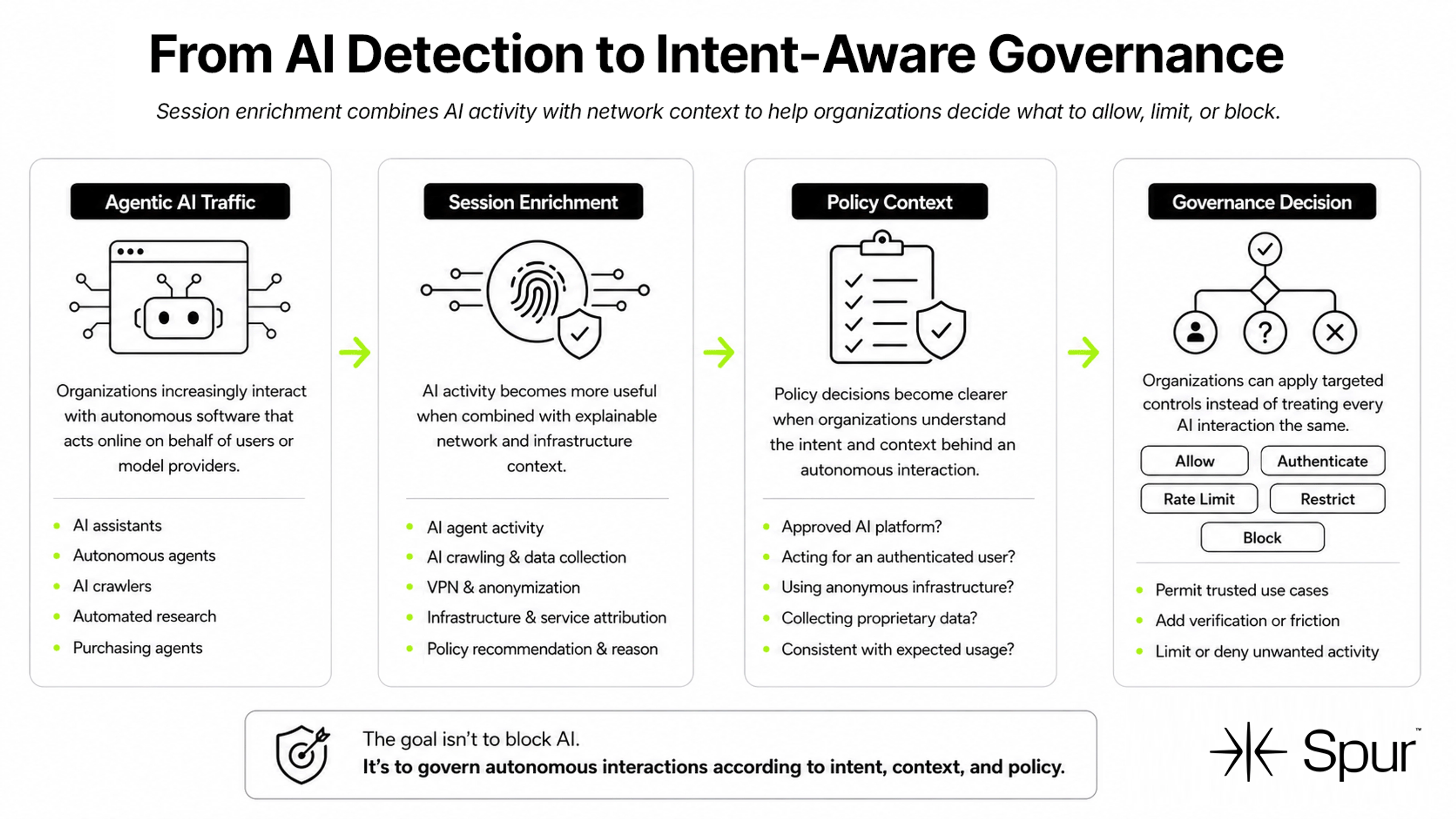
How Session Enrichment Helps Govern Agentic AI Traffic
Consider the session assessment below. Viewed independently, none of these attributes explicitly proves malicious intent. Together, however, they describe an autonomous interaction executing through a known anonymization provider.
Example Session Assessment
{"allowed": false,"reason": "Anonymous connections blocked","assessment": {"vpn": true,"proxied": false,"anon": true,"rdp": false,"dch": true,"cc": "US","ip": "146.70.202.60","ts": "2026-07-07T23:54:48Z","complete": true,"id": "35ea59be-539d-4f65-b699-77ddc13c5df2","sid": "test-app","service": "PROTON_VPN",“cpd”: “test-cpd-value”,"ai_agentic": true,"ai_crawling": true},"decisionId": "1a08c38d-810e-4a90-8705-dd3d9a76c529"}
Even without the benefit of self-declared AI crawling, this type of context enables more informed policy decisions, examined in the table below.
Signal | Why It Matters | Example Policy Action | |
allowed | Returns a policy recommendation immediately consumable by Cloudflare Workers, API gateways, or policy engines. | Allow, challenge, rate-limit, or block autonomous interactions without writing custom decision logic. | |
reason | Explains why the interaction exceeded policy, making governance transparent. | Log enforcement decisions, support audits, and tune AI governance policies over time. | |
vpn | Many autonomous platforms distribute requests through commercial VPN providers. | Apply lower extraction limits, require authentication, or reduce API quotas. | |
anon | Anonymous infrastructure often indicates deliberate concealment of origin. | Restrict premium content, block model-training access, or require verified identities. | |
dch | Data-center infrastructure is commonly associated with high-volume automation. | Apply stricter rate limits or require authenticated API access. | |
service | Identifies the specific anonymization provider instead of simply labeling traffic as VPN. | Build provider-specific governance policies and investigate recurring abuse campaigns. | |
ai_agentic | Indicates whether the session is associated with autonomous AI agents acting on behalf of users. | Permit customer-authorized AI assistants while applying additional controls to unknown autonomous agents. | |
ai_crawling | Indicates whether the session is associated with AI data collection or model-training activity. | Protect proprietary content, documentation, pricing, or APIs from unauthorized AI harvesting while allowing approved crawlers. | |
decisionId | Creates a durable record of every governance decision. | Correlate enforcement across Cloudflare, SIEMs, Trust & Safety investigations, and customer support cases. |
Building Policies for Agentic AI Traffic With Session Enrichment
In addition to traditional network intelligence, session enrichment distinguishes autonomous AI activity from conventional anonymized infrastructure through dedicated AI indicators. Organizations can separately identify agentic AI interactions acting on behalf of users (for example, ‘ai_agentic’) and AI crawling activity intended to collect data (for example, ‘ai_crawling’), enabling policies that distinguish legitimate AI assistants from unauthorized data harvesting.
With this additional insight, organizations can for example:
- Allow OpenAI retrieval while restricting unknown autonomous scrapers.
- Permit AI assistants for authenticated customers while requiring additional verification for anonymous sessions.
- Apply stricter rate limits to autonomous traffic using commercial VPN infrastructure.
- Allow enterprise automation while blocking sessions originating from consumer proxy networks.
How Spur Monocle Helps Detect and Govern Agentic AI Traffic
As autonomous AI becomes a permanent part of the internet ecosystem, organizations need more than bot detection – they need policy-driven governance. Spur Monocle complements existing CDNs, WAFs, bot management platforms, fraud engines, and API gateways by returning an explainable, policy-ready session assessment for every interaction. Each response includes an enforcement recommendation, the reason behind that recommendation, the supporting session assessment, and a unique decision identifier that enables consistent governance across security and business systems.
Beyond identifying anonymized infrastructure, Monocle also provides dedicated AI indicators that distinguish agentic AI interactions from AI crawling activity. Combined with network intelligence such as VPN usage, data center hosting, anonymization detection, and attributed network services, organizations can build nuanced policies that allow trusted AI assistants, regulate autonomous workflows, protect proprietary content from unauthorized model training, and manage AI-driven automation according to business requirements.
Rather than replacing existing security controls, Spur Monocle provides the missing session layer that enables smarter, more transparent governance of autonomous interactions while reducing false positives and preserving legitimate AI innovation.
Get 100,000 Session Assessments Every Month for Free
See how session enrichment can help you detect and govern agentic AI traffic using AI-specific indicators alongside VPN, proxy, anonymization, and infrastructure signals. Sign up for Spur Community to get 100,000 session assessments per month at no cost, or get pricing for higher-volume and enterprise requirements.
See the Difference Between Raw Data & Real Intelligence
Start enriching IPs with Spur to reveal the residential proxies, VPNs, and bots hiding in plain sight.